Jan 30, 2007

Everybody Really Is a Critic... And It's Usually Awesome

I stumbled upon a cool little music site, today, called rateyourmusic.com. The site lets you review singles and albums by just about everybody and his cousin. It's not the prettiest site or chock full of features, but for music geeks it's a good place to look for other, uh, music geek opinions.

Evidence of a Freemason-Redneck conspiracy

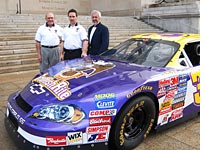
After such illustrious Nascar sponsors as Skoal, Copenhagen and Viagra, the illuminati-loving Scottish Rite of the Freemasons are now sponsoring a race car (of the type that only turns left). It turns out that the Masons were able to forego the usual multi-million dollar sponsorship fee in exchange for some mysterious promise of access to the secret society's members. Slate's reporter asked the race team's owner why he went with the Masons:

I called Joe Hill, head of public relations for Brian Conz's racing team, and asked him to explain how he expected to make up this missing money. What is the team getting from the Scottish Rite in lieu of all that cash? "We're aligning ourselves with a dynamic, worldwide organization. We expect access and introduction to their members, who will assist us in meeting executive-level corporate leaders interested in getting involved with racing." Presumably, these rich and important men (because there are no female Masons, after all) will prove useful in sponsoring race teams down the line.
In my opinion this proves the conspiracy!

Swedish Government Takes To Second Life

Second Life, a sort of on-line version of The Sims, is getting more and more like the "real" world it ostensibly imitates. You know the game (is it really even a "game" at this point) is venturing further and further into virtual reality territory when you can conduct semi-official business in it. The Swedish government is even building its own virtual embassy inside the game. I wouldn't be surprised if other government agencies and a lot more big corporations move into the game. Here's Ars Technica on Sverige's Second Life experiment:

The Swedish Institute hopes that the virtual embassy will be modeled after the the newly-opened House of Sweden in Washington DC, and has it begun formal negotiations with its architect, Gert WingÄrdh, for rights to create a digital version of the building, according to Swedish newspaper DN. In addition to getting tourist information, users in the virtual world will be able to browse displays, click links to informational sites about Sweden (most notably the Swedish Embassy's digital portal), and get visa information.

Jan 29, 2007

13 of Every 100 Americans now Officially Clueless

A survey of world attitudes about climate change revealed this week that 13 percent of Americans have never heard of global warming. Of course, maybe even more troubling is how many of compatriots actively refuse to believe in global warming. Here's Reuters:

The United States emits about a quarter of all greenhouse gases, the biggest emitter ahead of China, Russia and India.

Thirteen percent of U.S. citizens said they had never heard or read anything about global warming, the survey said.

It amazes me how flippant we Americans continue to be about this issue. I can't even imagine how tortured this must make climatologists and other scientists who've been ringing alarm bells for years trying to make us take global warming seriously. I really do wonder if this might eventually tarnish Bush's reputation among historians of the future when they look back at how little was done on this issue while he was in office.

Don't Eat Anything Your Great-Great-Grandmother Wouldn't Recognize as Food

Every once in a while a news article comes along that so thoroughly recasts the world around us that we're essentially not the same people once we've read it. It's certainly not an everyday occurrence, but most every serious reader has experienced this feeling at some point or another (for me, it's usually a New Yorker article).
Anyway, this week's New York Times magazine has a mind-blowing essay by Michael Pollan, the author of "The Omnivore's Dilemma." The essay, "Unhappy Meals," argues that the Western diet has followed a disastrous philosophy of "nutritionism," that food science has been so thoroughly co-opted by industrial food producers that we can no longer make the distinction between actual food and food-like substances.
The essay's scope is wide and expansive, but he does offer a quick nine-point plan for reclaiming the traditional (and non-processed) diet that allowed human civilizations to thrive. My favorite bullet point is his first piece of advice:

1. Eat food. Though in our current state of confusion, this is much easier said than done. So try this: Don’t eat anything your great-great-grandmother wouldn’t recognize as food. (Sorry, but at this point Moms are as confused as the rest of us, which is why we have to go back a couple of generations, to a time before the advent of modern food products.) There are a great many foodlike items in the supermarket your ancestors wouldn’t recognize as food (Go-Gurt? Breakfast-cereal bars? Nondairy creamer?); stay away from these.

Jan 25, 2007

C'est Joost


It's still in beta testing, but I'm hearing more and more about Joost, which theoretically will be some type of broadband (Internet) TV service that streams real TV channels onto your computer (and probably your TV box eventually). So far it looks promising. I like how they plan to use iTunes-style "playlists" to help users organize content. Probably the best thing for consumers, though, will be its a la carte format-- you'll get what you want without paying for 99 channels worth of Spanish telenovelas, professional bull riding and cop shows.

Sorry State of the Union

Juan Cole, a professor at the University of Michigan (and genius blogger) has his own response to some of the statements by Bush's State of the Union speech this week. Cole, an expert on Middle East politics, pretty much rips apart every contention the president made. It's not a pretty picture if you pick the speech apart and look at the strategy (or lack thereof) in Washington for dealing with the greater Arab world.

Eye Asparagus

     Whatever the opposite of eye candy is, that's my blog. Luckily, my boy James (a co-worker, natch) helped me out with a CSS issue I was having. Look for some visual improvements in the coming weeks as I get acquianted to my new home and start spiffening this place up. Spiffening is a word, right?

Pray We Never See 24-7 Dallas Cowboys TV

There's a good story today about the renewed challenge against the NFL's broadcast antitrust exemption, spurred on by baseball's move to negotiate an exclusive contract with DirecTV. It could eventually lead to NFL teams negotiating their own TV rights, which would have huge effects on the league. From Football Outsiders:

There’s a larger issue in play which has politicians jumping into the fray. In early December of last year, Sen. Arlen Specter (R-PA) said he would introduce legislation in the next session aimed at eliminating the NFL’s freedom from antitrust laws over how NFL Sunday Ticket is only available via DirecTV. If you’re scratching your head saying, “I thought only MLB had an antitrust exemption,” you’re not alone. Specter’s bill would repeal the NFL’s antitrust exemption under the Sports Broadcasting Act of 1961. Currently, the NFL negotiates the broadcast rights for all of its 32 teams. Specter’s bill would repeal that ability and set up a scenario in which teams would negotiate television deals separately. If it were to become law, wave bye-bye to one of the strongest methods for creating parity in the NFL: centralized television revenues.

I Knew I Should Have Paid Attention in Science Class

Wired has an interesting collection of 40 big questions not yet answered by science. It's a good read. My personal favorites are: "Is Time an Illusion?" (I don't think they're referring to the magazine, but maybe) and "What Happened to the Neanderthals?"

Jan 24, 2007

Reach Out and Unlock Someone

CNet has a great little story today on why we're likely to see more and more "unlocked" cell phones coming into the U.S. market. Unlocked phones are devices that can be used on any carrier's network, instead of the current model where cellular carriers subsidize the cost of new phones to attract adn retain customers. Notice this juicy little nugget about the iPhone:

But experts say tiny cracks are forming in the current model that could challenge mobile operators' dominance whether they like it or not. Apple, with its iPhone, has the brand recognition and established retail channel to easily sell millions of devices on its own. Initially, that device, whose price starts at $499, will be sold exclusively through Cingular. But experts say it's possible that Apple may eventually sell it directly to consumers.

"I think the first time there will be a threat will be if Apple unlocks the iPhone and sells it in its stores," said Lin. "It's already priced near the high end, so subsidies won't make much difference, and Apple already has such good brand recognition."

Microsoft Really Can Make an OS That Looks Good?

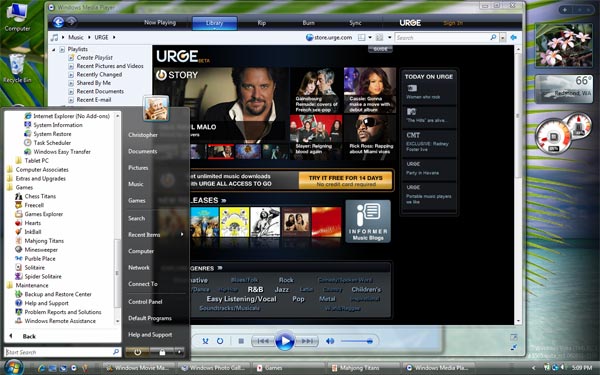
Yes, if you believe Paul Boutin's review of Vista in Slate. He describes a visually exciting update of the PC's operating system. Just how far Redmond has to go is obvious to anyone who uses OS X on a Mac and then gets thrown back into the freezing cold swimming pool of XP ugliness. Boutin makes a great point about all the bells and whistles, though:

Operating systems shouldn't be exciting. Like a good government, a good OS should mostly get out of the way. It needs to stay up and running, prevent invasions from intruders, and avoid ugly surprises. When judged by those criteria, Vista is up to the task.
He goes on to say that Microsoft got religion on security and is now taking its various flaws more seriously. A lot of people remain skeptical, though, and you can be guaranteed there will be hundreds of indignant journalists writing anti-Gates screeds as soon as Vista's problems bubble to the surface. They'll be right, of course. Nonetheless, if you don't want to buy into the Apple worldview (err, price structure) and aren't ready to spend weekends learning Linux, you're stuck in Gates' world, and well... we're just living in it.

Jan 23, 2007

No, Your Cousin Pookie Isn't Sending You His Weather Forecast

Hundreds of thousands of home computers have been hit by the "Storm Worm," a piece of malicious little code that's been spreading like restless legs syndrome (yes it's contagious) because apparently computer users will open e-mail attachments if they feel it will give them some good information about a recent bout of severe storms in Europe. Here's CNet giving us the big picture on what's going on:

Once a user downloads the executable file, the code opens a backdoor in the machine which that it to be remotely controlled, while installing a rootkit that hides the malicious program. The compromised machine becomes a zombie in a network called a botnet. Most botnets are currently controlled through a central server, which--if found--can be taken down to destroy the botnet. However, this particular Trojan horse seeds a botnet that acts in a similar way to a peer-to-peer network, with no centralized control.
Each compromised machine connects to a list of a subset of the entire botnet--around 30 to 35 other compromised machines, which act as hosts. While each of the infected hosts share lists of other infected hosts, no one machine has a full list of the entire botnet--each has only a subset, making it difficult to gauge the true extent of the zombie network. As complicated as all that sounds (botnets and rootkits do sound like some type of killer robot), the truth is that this whole situation is easily preventable. Short of entirely shutting off e-mail (you might as well kill us!), all it takes is a little vigilance. Stop opening e-mail attachments.
Even if the sender is someone you know, their e-mail client could be compromised. Simply never ever open an attachment that you aren't 100% expecting to receive. If an email seems out of ordinary, delete the message completely or ask the sender what it is. I know this sounds obvious, but when hundreds of thousands of computers are being turned into spam-spewing zombies, you have to wonder what people are thinking when they fire up the ole' e-mail box.

Jan 22, 2007

Not Every Tech Story Out of China is about Piracy

Even if China sometimes seems like a giant den of intellectual property theft, the somewhat large (so we hear) nation is taking its own steps toward a homegrown tech industry by introducing computers with more locally-made parts than ever. The boxes, manufactured by Lemote Technology, will have Chinese-built processors, 40-gig hard drives and run Linux. The best part? They will retail for around $200 US. According to Tech.Blorge, the Chinese chip-building program didn't even start until 2001 and that an all-Chinese computer is a big step:

Does this mean we will see a rash of computers from China coming on sale? In fact, this has been the case for a long time. It is just they had different labels: IBM (now Lenovo), Dell, Hewlett-Packard and the rest. The only differences were that these were badged machines that ran an Intel chip and Microsoft Windows.

Now the Chinese computers can run a chip made in China and operate with Linux. And that is a wondrous revolution.

Sorry, I Can't Hear You.... My iPod Made Me Deaf

I love playing shuffle mode on my iPod, but the huge volume fluctuations from track to track are really bad sometimes. Here's a nice little article on how to fix your mp3 library.

When Chuck E. Cheese Just Won't Do

A new online group is encouraging parents to scale back childrens' birthday parties. The level of frivolity has apparently led to $38,000 shindigs for some lucky wee tots (as Super Nanny would probably put it). I'm all for dialing down the excess, but let's not pretend that it's just children who are benefitting from America's obsession with budget-busting bacchanalias (aliteration! woo). After all, pretty much every other life event is now celebrated with a small army of caterers. I doubt our grandparents were refinancing homes and maxing out credit cards (OK, they didn't have those back then, ahem) to pay for lavish bar mitzvahs, destination weddings and official Nascar-licensed caskets.

Jan 20, 2007

The Appropriately Named DJ Drama

A little story has popped up recently about the recent arrest of DJ Drama, a hip-hop DJ who recently released a mixtape. Anyone who knows the music will tell you that mixtapes are extremely common because the record labels themselves give their tacit permission to use their tracks. Think of it as a sort of low-budget marketing strategy that benefits everybody: fans can get the latest music in a low-cost format and artists get buzz before their next albums come out. Here's Ars Technica's brief summary:

The RIAA isn't pleased with "Gangsta Grillz," which are rap compilations that usually contain unlicensed music. The albums are widely seen as promotional tools by the rappers who willingly participate, but formal permission to use the tracks is not obtained from the record labels who own the rights to them. The mixtape scene has thrived for years without arrests, so the sudden bust of a high-profile figure came as something of a shock.

Jan 19, 2007

The Burning Crusade Against Good Writing

The NYT has a story about the release of The Burning Crusade, a new expansion pack for World of War Warcraft (an absurdly-popular online version of dungeons and dragons). The writer, though, attempts (unsuccessfully) to explain the popularity of the new game expansion:


The Burning Crusade, as the set is titled, went on sale at midnight Tuesday. For people who don’t play online games, it can be a little difficult to describe the freakout many gamers experience as they try to explore and conquer the new content. Imagine the convergence of rabid fans if, say,
Luciano Pavarotti were to star in a long-hyped live remake of “Star Trek” at Carnegie Hall, with special appearances by Tom Cruise and Kiefer Sutherland.

It’s a bit like that, except for people who mostly don’t read People, care about Jack Bauer or subscribe to the Met.

If you can actually understand what he's trying to say, post a comment. I'm stumped.

Latest and Greatest Gadgets

Popular science has a little slide show of their favorite new tech gadgets from CES, the mega-trade show for consumer electronics. Most of the stuff doesn't blow me away, but I really do like the iPod video projector. As a friend of mine mentioned recently, home video projectors seem like they could really explode (figuratively) in the next few years if the price of the lenses keeps coming down.

Jan 18, 2007

Technical Difficulties

Blogger went down for a few hours today (I was actually getting this funny-looking Google error page). Sorry for the lack of posts, but I'll get back to it asap.